
Dyslexia intervention · Johor Bahru
Teaching reading to children it did not come easily to
One method, delivered three ways. What changes between them is the room and the number of children in it — never how carefully the reading itself is taught.
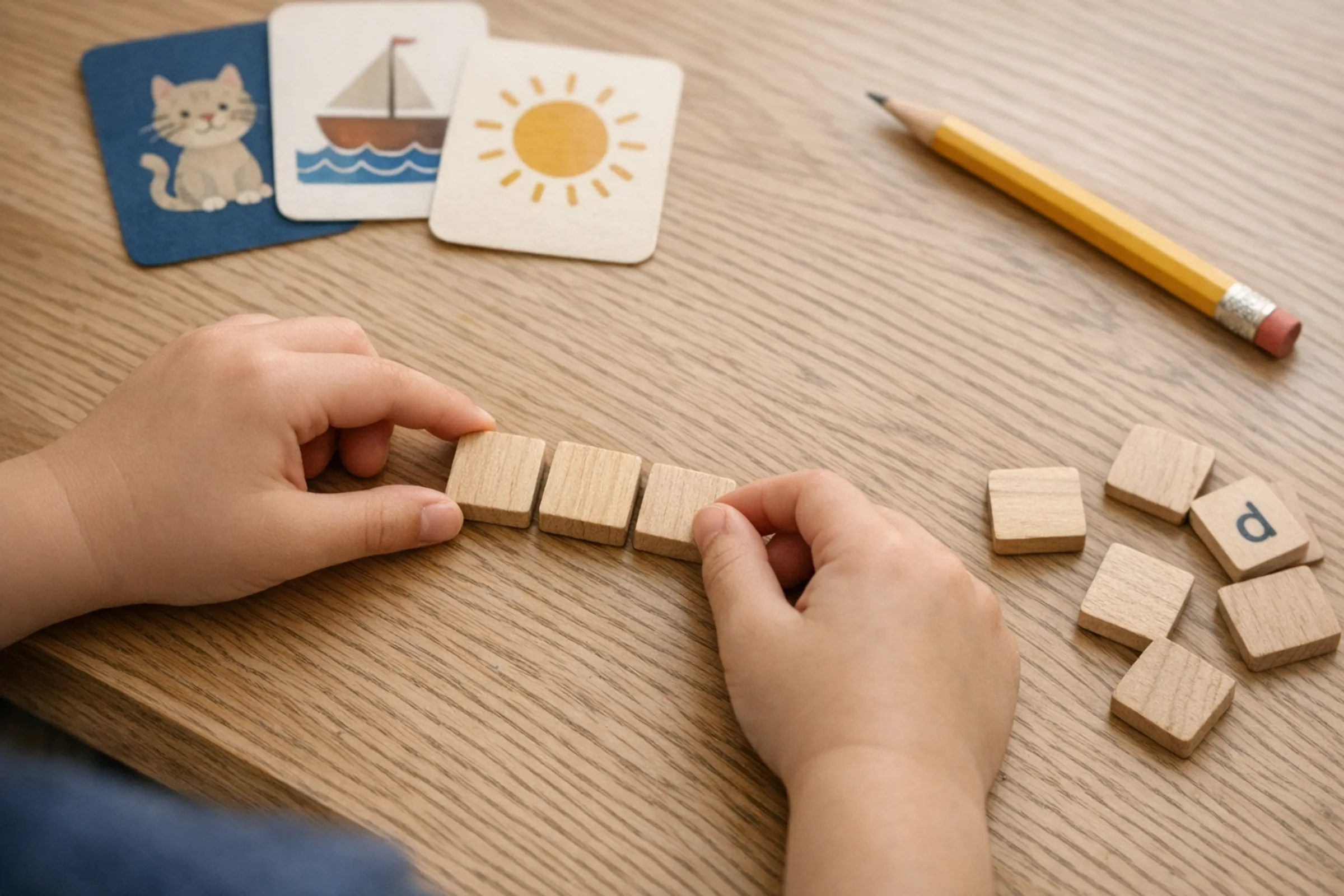
The problem with practice
Reading more is not the same as being taught to read.
Almost every family arrives having already tried harder. That is worth saying plainly, because it is usually the first thing a parent quietly blames themselves for.
More reading is not more teaching
The usual response to a struggling reader is volume: read more at home, more often, for longer. For a child who has not been taught how the code works, that is repetition of guessing. They get faster at guessing.
Whole-word memorising runs out
A child can memorise the shape of a few hundred words and look like they are reading. Somewhere around Year 3 the vocabulary outruns memory, the wheels come off, and everyone is surprised — except the child, who has been bracing for it.
Confidence collapses before skill does
By the time reading is visibly behind, a child has usually spent two or three years concluding something about themselves. That conclusion gets in the way of the teaching that would fix it, which is why we treat it as part of the work rather than a side effect.
Structured literacy
Five things that are true of every session we teach.
This is the method, and it does not change between a group, a one-to-one session and a kitchen table.
Explicit
Every pattern is taught, not inferred. Nothing is left for a child to notice on their own — noticing is precisely the thing that is hard for them.
In order
Sounds and patterns are taught in a sequence where each one rests on the last, so a child is never asked to apply something they have not been given yet.
One thing at a time
A session introduces a single new concept. Two feels more efficient and reliably teaches neither.
Practised until automatic
A pattern that has to be thought about still costs attention that should be going to meaning. We keep going past the point of knowing it, to the point of not needing to think about it.
Applied in real text
Word lists are where a pattern is learned; a page is where it becomes reading. Every session ends up in connected text, not on a worksheet.
Three ways in
Which one your child needs is decided by the assessment.
You are not expected to choose from this table. It is here so you know what exists and roughly what it costs before you talk to us.
| Programme | Size | Where | Best when | Fee |
|---|---|---|---|---|
| Small-group interventionPrimary programme | Up to five matched learners | At the centre | A child can work alongside others, and a running group matches their decoding stage. | RM90per child, per session |
| Individual intervention | One to one | At the centre | The gap is wide, or attention and anxiety make a shared room hard right now. | RM120per session |
| Home support & parent coaching | One to one, plus you | In your home, by appointment | Travel is the obstacle, or the work needs to continue at your own table to stick. | Contact us |
Fees change on 1 January 2027. See pricing and packages →
Whichever one
What is the same in all three.
- An assessment first — no child is placed in a programme we have not matched them to
- Structured literacy throughout, whichever way it is delivered
- Individual goals, even inside a group
- A written record of every session, in language you can hand to a teacher
- Home practice that takes minutes, matched to what was taught that day
- An honest recommendation to change programme when the current one is not working

Read more
Each programme in full.
Small-group intervention
Up to five matched learners · At the centre
A child can work alongside others, and a running group matches their decoding stage.
Our primary programme →Individual intervention
One to one · At the centre
The gap is wide, or attention and anxiety make a shared room hard right now.
Read more →Home support & parent coaching
One to one, plus you · In your home, by appointment
Travel is the obstacle, or the work needs to continue at your own table to stick.
Read more →Questions parents ask
About choosing between them.
How do we know which programme is right?
You do not have to decide — that is what the assessment is for. Families often arrive certain they want one-to-one and leave placed in a group, or the reverse. We would rather make that call from evidence than from whichever option sounded best over the phone.
Is one-to-one better than a group?
Not automatically, and we say so even though it is the more expensive option. For a child who is losing confidence more than skill, a matched group is often the better answer, because hearing four other children work through the same difficulty does something no adult can do one to one.
Can we change programme later?
Yes, and children often do — most commonly from individual sessions into a group once they are ready for one. A placement is our best judgement at the time, not a decision anybody has to defend.
Do you work with children who have other diagnoses?
Often. Reading difficulty frequently sits alongside attention difficulties, speech and language needs, or autism. What we teach is reading, and we are clear about that boundary — where another professional's help is needed, we say so and point you toward one.
What if reading is not the main problem?
We will tell you. An assessment sometimes concludes that what is getting in the way is not primarily literacy at all, and starting a reading programme would have been the wrong first move. That outcome costs you an assessment and saves you a year.
Start here
You do not have to work out which one first.
Register, and the assessment will tell us — including if what your child needs is something we do not offer.