
True DreamJohor Bahru

Before any programme

Understanding your child before we teach them

Every child starts with understanding where they are. Until our assessment packages open in January 2027, that begins with a free first conversation and a short screening — because we cannot teach a child well until we know exactly which parts of reading have never been taught to them.

Assessment materials laid out on a desk: a word list, a record sheet, a pencil and a stopwatch
Illustrative image

Scope

What an assessment is — and what it is not.

We want to be exact about this, because the word “assessment” is used to mean very different things by very different professions.

What we do

  • A structured look at how your child reads, spells and writes
  • Which sound–letter patterns are secure, which are shaky, and which have never been taught
  • How your child approaches a word they do not know
  • Where attention, memory or confidence is affecting the reading
  • A teaching plan: what to teach, in what order, at what pace
  • An honest recommendation — including when that recommendation is not us

What we do not do

  • Not a diagnosis of dyslexia, ADHD, autism or any other condition
  • Not a medical or psychological assessment — we are an education service
  • Not a prescription, treatment or therapy
  • Not a report for legal, medical or insurance purposes
  • Not a substitute for a formal diagnostic assessment where you need one

True Dream is an educational intervention service. We do not diagnose dyslexia or any other condition, and we do not provide medical treatment. Our assessment describes how your child learns and what teaching will help. Where a formal diagnostic assessment would be useful to you, we will say so and point you toward qualified professionals who can carry one out.

Assessment options

Four ways in, depending on how much you already know.

If you are unsure which one fits, start by asking us — that conversation costs nothing and often settles it in a few minutes.

Learning Needs Screening

A first structured look, when you are not yet sure there is anything to look at.

Available from 1 January 2027RM250 per assessment

  • A structured conversation about what you have been noticing
  • Short screening tasks across reading and spelling
  • A clear answer on whether a fuller assessment is worth doing

Best forFamilies at the beginning, who want a starting point before committing to anything.
Focused Literacy Profile

The detailed literacy picture most children start from.

Available from 1 January 2027RM550 per assessment

  • Decoding and phonological awareness
  • Reading accuracy and fluency in connected text
  • Spelling patterns and where they break down
  • Writing at word and sentence level

Best forA child whose difficulty is clearly centred on reading, spelling and writing.

Comprehensive Learning Profile

The fullest picture we offer, when the difficulty looks broader than reading.

Available from 1 January 2027RM850 per assessment

  • Everything in the Focused Literacy Profile
  • Attention, working memory and learning behaviour
  • Oral language and comprehension
  • How the pieces interact — which is usually the useful part

Best forWhere school has raised several concerns at once, or reading is only part of it.

Progress Reassessment

Where a child has got to, and what should change next.

Available from 1 January 2027RM350 per assessment

  • Re-measuring the areas the original profile identified
  • What has moved, what has not, and why
  • A revised teaching plan for the next period

Best forChildren already in a programme, at a review point.

The four assessment packages open on 1 January 2027. Until then, every child starts with a free first conversation and a short screening. See pricing and packages →

What happens

From your first message to a plan you understand.

  1. 01

    Before we meet

    A conversation about what you have been noticing, and anything school has said. You know your child better than any test does, and it shapes what we look at.

  2. 02

    With your child

    Structured tasks, one to one, in a quiet room. They are paced so a child is working at their edge without being pushed past it — and we stop if a child has had enough.

  3. 03

    Scoring and analysis

    Afterwards, not in the room. What matters is not a single score but the pattern across tasks — where the same weakness keeps showing up.

  4. 04

    We talk it through

    In plain language, with you, in a conversation — not a PDF emailed over with a number in it. You should leave understanding what we found and what you would do next.

  5. 05

    Your written profile

    A written record of what we found and what we recommend, in language you can hand to a teacher.

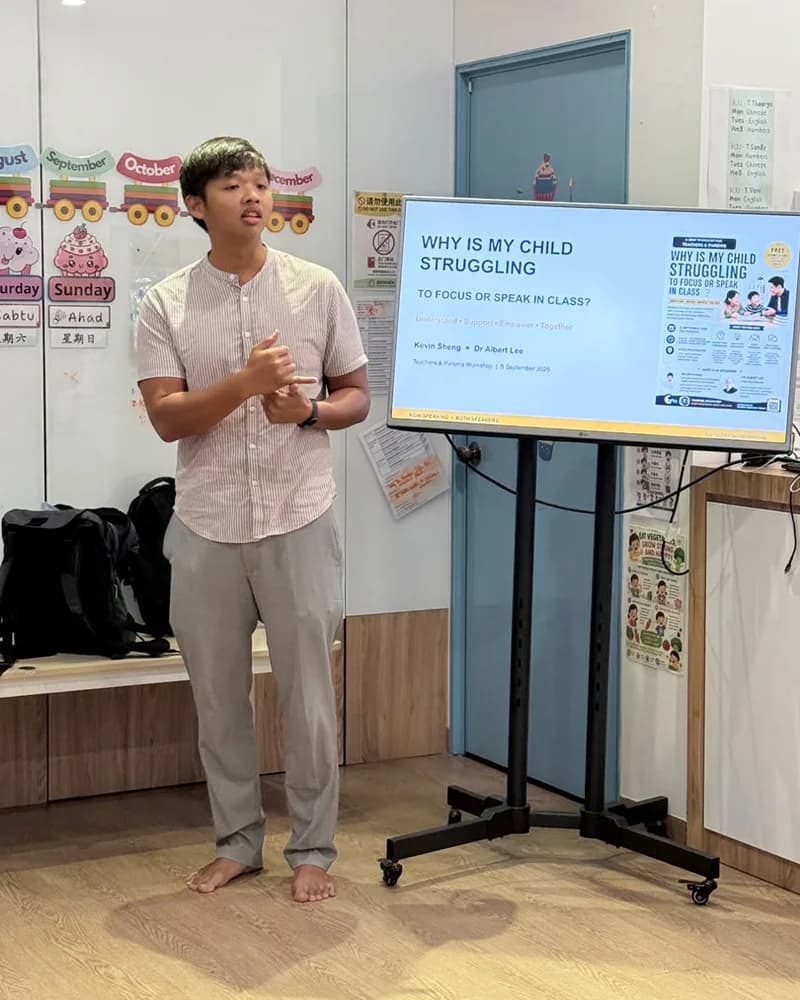
Kevin Sheng speaking beside a slide that reads Why is my child struggling to focus or speak in class

Honest outcomes

Sometimes the right answer is somebody else.

Reading difficulty sometimes turns out to be sitting on top of something else — a speech and language need, an attention difficulty, or something in vision or hearing worth ruling out first. When that is what we see, we say so.

We keep relationships with professionals we trust for exactly this reason, and we will point you toward the right one rather than starting a programme that was never going to be the answer.

Professionals we work with

Afterwards

What the assessment decides.

It is the assessment, not the timetable, that determines what we recommend.

Small-group intervention

Where a child matches a group we are running — similar decoding stage, compatible attention and confidence. Our primary programme, and where most children make their fastest gains.

About small groups →

Individual intervention

Where the gap is wide enough that a group would hold a child back, or where attention or anxiety makes a shared room hard right now.

About individual sessions →

Home support or coaching

Where travel is the obstacle, or where the most useful thing we can do is hand you the structure to run at your own kitchen table.

About home support →

Questions parents ask

About the assessment itself.

Do you diagnose dyslexia?

No. We are an educational intervention service, not a medical or psychological one. Our assessment describes how your child reads, spells and writes, and what teaching will help. If a formal diagnosis would be useful to you, we will say so and point you toward qualified professionals who can carry one out.

Does my child need a diagnosis before we come?

No. Most families come to us without one, and many never need one. What we need is an assessment of our own, so that any programme we recommend is matched to your child rather than to the next available place.

Can I use your report for school or exam arrangements?

Our profile is written to be useful to a classroom teacher, and schools generally welcome it. Formal access arrangements for examinations usually require a report from a qualified psychologist or specialist assessor — that is a different document, and we will tell you plainly if that is what you need.

Should my child prepare?

No — and please do not practise with them beforehand. We need to see where they are, not where a weekend of coaching can get them. Tell them they are coming to do some reading activities with someone who wants to see how they think.

Will my child feel tested?

Some of it does feel like schoolwork, and we do not pretend otherwise. What we can control is the register: one adult, one child, no class watching, no clock on the wall, and permission to find things hard.

What if we decide not to go ahead with a programme?

That is a perfectly normal outcome and there is no pressure attached. The profile is yours either way, and some families take it to their school or to another provider. We would rather you had an accurate picture than a place in our timetable.

What if you think we need someone else?

We say so. Reading difficulty sometimes turns out to be sitting under a speech and language need, an attention difficulty, or something in vision or hearing worth ruling out first. Sending you to the right person is a better outcome for your child than enrolling them here.

Start here

Register, and we will take it from there.

Registering opens an account and starts the assessment conversation. There is nothing to pay to ask, and no programme is chosen until we have understood your child.